Growing up queer is an inherently difficult experience. Whether you’re fortunate enough to have a family that supports you along the way, or ill-fated to years of being misunderstood or shunned, there’s an entire outside world waiting to shame you–simply for being who you are. The discomfort that comes along with this experience is then exacerbated by the notion of visibility. Meaning, the more “queer” you show up as to the world, the more difficult your experience as a queer person will be. And this understanding of the way the world works is not in the slightest a new phenomenon.
For years and years now, the queer community has familiarized itself with the art of assimilation. Coining terms like ‘realness’ and ‘trade’, there’s always been a glorification of the ability to homogenize or to blend in with the rest of the world. And although there are subcultures abroad and groups of people that share similar sentiments worldwide, queer people are unique in that these efforts often are rooted in a need for safety. There’s this age-old quote that says “to be visibly queer is to choose your happiness over your safety,” and truer words have never been spoken.
Growing up, though, was a bit different. I never made a decision to show up to the world as my most authentic self–I just did. And as with most children who have yet to be indoctrinated with homophobia or the societal devaluation of femininity, I was unaware of the norms that would soon plague my everyday life. For the entirety of my childhood, though, it was clear to just about everyone that I was queer. My sexuality has never come as a shock to anyone, and I’ve never had the luxury of “passing” as a straight man. Keeping this in mind, I’ve always been of the sound belief that much of the queer experience is rooted in the way that you are perceived by the world.
And because sexuality and gender exist on a spectrum, that statement isn’t entirely untrue. Your lived experience is closely tied to the way that you show up to the world. The same is true of race. Characteristics you have are assumed and then assigned value based on how you present—influencing the way that you are treated. This fact of life hardened me to the struggles of queer people who have yet to walk in their truth.
After all the years that I had spent defending who I was, and all of the loved ones I’d lost to antiquated beliefs, I had little to no grace for those who hadn’t endured the same things. The experiences of “straight-passing” queer folk and closeted gays seemed to hold less weight to me. And the troubles they faced seemed to pale in comparison. I was able to understand the cost that comes along with owning your truth, and so I couldn’t excuse those who decided not to pay it.
It wasn’t until recently, upon watching Heated Rivalry, that I had a change in view. Forbidden love and queer angst are not at all new tropes, but they are facts of life for many. Those things, in and of themselves, did not change my mind, though. It was the characterization of each person and the exploration of their individual conflicts that widened my worldview. Standing alone, sacrificing family, and facing adversity had become such a fact of life that I almost normalized the pain that comes along with experiencing these things. I’d done a disservice to so many people who were deserving of support by writing them off as weak or unwilling. The fact of the matter is that it’s so much more complicated than that.
As queer people, we get to choose our family (yes, a RuPaul quote–I don’t care,) but often that choice comes only after being deprived of the one that we’re born into. And this can be deeply disorienting. Giving up your long-established systems of support and forsaking the people who you’ve built those systems with to honour yourself is a tall order. The show beautifully explores what it feels like to harbour resentment for the people who can’t seem to understand you and still wanting to appease them because of the nature of the relationship.
Ilya, in particular, goes through this throughout the entire season. He struggles to come to terms with losing his family (literally and figuratively), while also taking care of them and actively despising them for it. His story speaks to the experience that queer people have when we’re constantly tasked with being the bigger person. We’re expected to give grace to our elders, excusing their hateful ideology under the guise of generational disconnect. We’re asked to constantly educate others on the experience, acting as historians and archivists. We wind up having to micromanage so much of our lives that we don’t even get to thoroughly enjoy living them.
Shane’s struggle is different in that his reluctance to come out is rooted mostly in his assumptions of the way he will be received. He does not face national extremism or persecution in the way that Ilya does being Russian, nor does he face family estrangement. He has assumed that his coming out will ostracize him–likely due to the conditioning of our society and his own first-hand experience witnessing how queer people are treated when they do walk in their truth. There is an unwillingness to let go of the privilege that straight, all-American white boys are often given as a birthright, and a deep desire to maintain his sense of identity if he does.
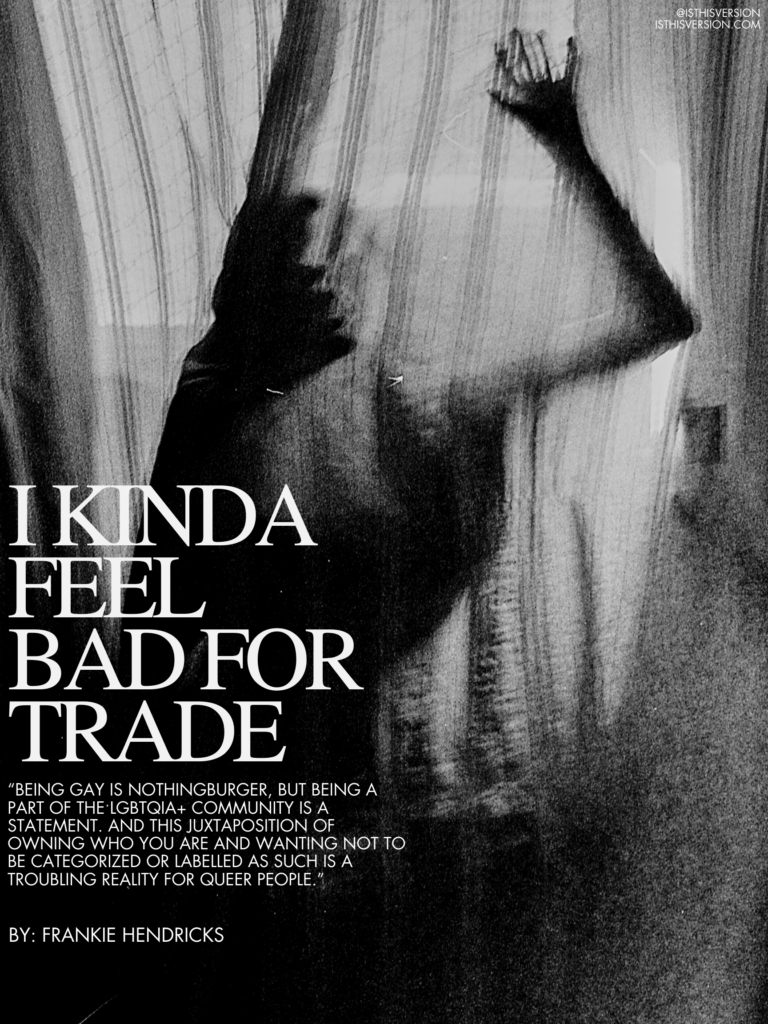
In watching, I came to understand the complexity of these types of situations. What’s more, I understood just how intimidating the process itself can be. Queer culture is a vibrant community full of thriving subcultures, home to countless pioneers of change. And as time moves on, it transmutes a community and becomes more of a movement. To someone—anyone, really—with a solidified brand or an established sense of self, though, something as massive as the LGBTQIA+ community can be intimidating. And for whatever reason, coming out in recent times has felt less like a personal moment and more like a ceremonial induction into an entirely new society. Being gay is nothingburger, but being a part of the LGBTQIA+ community is a statement. And this juxtaposition of owning who you are and wanting not to be categorized or labelled as such is a troubling reality for queer people.
After finishing the season finale, my mind ran rampant, drawing parallels to my own life and to the lives of the people I’ve come to know. Although I wasn’t able to directly relate to these characters, I could compare their stories to those of the people I had met over the years. I couldn’t help but think about how this experience is compounded within the Black community. Taking into consideration the asinine, unattainable expectations we have for Black men, it should come as no surprise that many feel inclined to suppress the feelings they have. (Sidenote: Men of every single race are guilty of perpetuating patriarchal ideology, but they unknowingly fall victim to it as well, and as a result are held to gendered stereotypes. There is, however, an undeniable difference in the treatment of Black men and their counterparts— resulting in a deeply disordered community of men.) The problem is so much more complicated than we’re led to believe.
For so long, though, I had grossly oversimplified the situation—boiling it down to someone not having the balls to stand in their truth. Family be damned, regardless of safety, and without restraint–you needed to be honest about who you were. But this undermines all the efforts that we make to ensure the safety of queer folk all around the world. Without first seeking to correct the society that demands us to conceal our lives, we cannot condemn those who simply comply with the demand. As queer people, we’re often forced into ultimatums. If you come out, you will lose your family. If you come out, your career could be impacted. And when we make a choice–we’re crucified. But those who act in self-preservation when given ultimatums are seldom guilty of malintent. And now, I kinda feel bad for trade. Stuck between both worlds, never truly living life to the fullest in either, bound to be punished–either by others or themselves. It’s actually sad.
So what can be done? How do we foster the space for others to come out? When can we, as a society, move forward in love and acceptance? Unfortunately, I haven’t got it all figured out. Aside from identifying the culprits (homophobia, misogyny, ambivalent sexism, etc.), there’s still so much work to be done. In the meantime, however, it’s becoming increasingly important to support the gays. As we move forward in our fight for equality, support for one another has never been more crucial. Try to give grace to the trade. Show a little love to your closeted sisters. And most importantly, be patient with yourself and with the people you encounter. We all deserve to write our own stories – trade included.
Disclaimer:
Trade is a term belonging to AAVE and refers to a African-American man that is “straight-presenting” or displays masculine characteristics. Trade is also used to refer to casual sex partners who do not self-identify as “gay”, but partner with other men based on a desire for companionship, sexual gratification, and or financial compensation.
Trade is not an all-encompassing term to describe “DL” men and very specifically refers to a category of men made up entirely of black people.
-Frankie Hendricks